
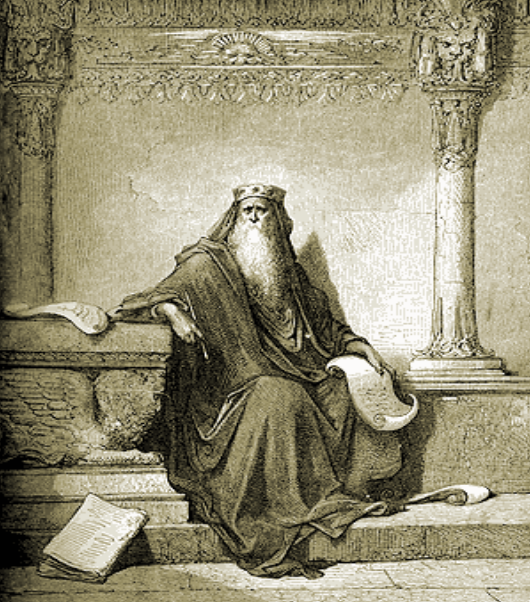
Image: Gustave Doré, Solomon writing Proverbs, c. 1866 / wikimedia
Weekly Bible Chapter: Solomon Used His Wisdom for Wise Purposes by Sarah Rudolph


Published: October 27, 2026
One of the key gauges of true wisdom - is to know what to do with one’s wisdom
What was it that moved the queen of Sheba to come test Solomon, and what did she discover?
“The queen of Sheba heard of Solomon’s fame, through the name of the LORD, and she came to test him with hard questions” (I Kings 10:1). What does “the name of the Lord” mean, and how could she test that?
Most commentaries explain that she had heard Solomon’s wisdom was so great that it must be divine, and so the queen came “with hard questions.” No one can possibly answer everything; if Solomon could, she would know his wisdom was supernatural. The Ralbag, however, suggests her interest may have been not the source of his wisdom but its direction – whether he utilized his wisdom “in God’s name” or not.
And indeed, after her questions and his answers, and her observations of his palace, she declared that “your wisdom and tov surpass the reports that I heard” (10:7). What sort of “tov,” goodness, did she observe? What might this mysterious queen have defined as “good”?
Some take it as “wealth” – which Solomon certainly had in abundance – but as the queen continues, it seems she saw something more: “It is because of the Lord’s everlasting love for Israel that He made you king to administer justice and righteousness” (vs. 10).
What is the truly impressive element of wisdom: having it, or using it to pursue justice and righteousness? That it was granted by God, or that God judged a person fit to wield such a gift?
After all, we know how Solomon got to be so wise: because he cared enough about justice to ask God for the wisdom to dispense it (3:9).
Perhaps, then, the questions of the source of Solomon’s wisdom and its direction are actually bound up with each other: his extreme wisdom came from God, who gave it to him precisely because of how he would use it. As Ralbag notes, the queen of Sheba witnessed the influence of that wisdom in everything Solomon did – from his table settings to the placement of his servants to his palace to his justice. And as Ralbag further suggests, his use of wisdom itself grew the wisdom: “She heard of him, that everything he did, he did for the sake of God… and because of this, he grew excessively in wisdom, because this is one of the great tools for acquiring wisdom.” A “tool” – not a unique divine gift, but something anyone can wield.
The fact that God granted Solomon wisdom was not in itself what really impressed the queen of Sheba.
Ultimately, the true source of Solomon’s wisdom was his own drive to do right with it, and such commitment is a tool available to us all, to motivate our own growth and permeate everything we do. And it is that commitment that can truly earn the respect of others.
Sarah Rudolph is a freelance Jewish educator, writer, and editor.
Avraham Norin shared this piece from one of this week's 929 many posts.
What is 929? Click on the link for more details: https://www.929.org.il/pages/aboutEN.html