
Weekly Bible Chapter: David Comes Not to Bury Saul, But to Continue His Dynasty by Tzvi Sinensky


Published: September 08, 2026
Starting from Ruth, acts of lovingkindness and loyalty are the bedrock of the Davidic dynasty
After mourning for Saul and Jonathan, David ascends to Hebron and is anointed there as king. Seeking to bring Saul’s backers on board with his rule, David reaches out to the community of Jabesh Gilead:
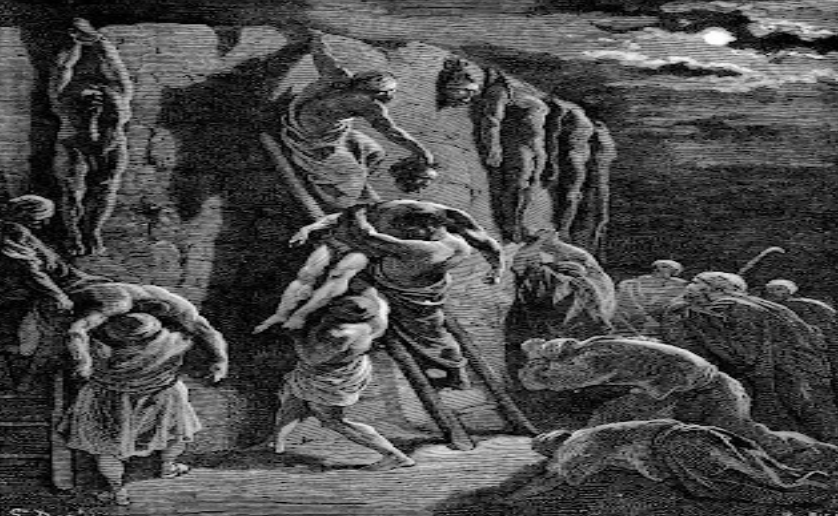
David was told about the men of Jabesh-gilead who buried Saul. So David sent messengers to the men of Jabesh-gilead and said to them, “May you be blessed of the Lord because you performed this act of faithfulness to your lord Saul and buried him. May the Lord in turn show you true faithfulness; and I too will reward you generously because you performed this act. Now take courage and be brave men; for your lord Saul is dead and the House of Judah have already anointed me king over them.” (v. 4-7)
Perhaps most remarkable in this series of verses is their parallels to the language of the book of Ruth, in which Ruth remains with her mother-in-law Naomi, and ultimately marries Boaz, whose children continue Naomi’s line. Naomi initially urges the women to return to their homes in Moab, exclaiming, “May the Lord deal kindly with you, as you have dealt with the dead and with me” (Ruth 1:8). Boaz is introduced as a “brave man” (Ruth 2:1). After Boaz makes sure to take care of Ruth by providing for her and Naomi, Naomi declares, “Blessed be he of the Lord, who has not failed in His kindness to the living or to the dead” (2:20). Boaz courts Ruth, calling her “a brave woman” (3:11). After Boaz and Ruth are married, the townspeople wish them that “they perform bravery in Efrat” (4:12). All these closely parallel David’s language in his communication with the people of Jabesh Gilead.
The essential storyline in Ruth concerns Boaz’s kindness in redeeming and continuing the line of Naomi and her deceased husband Elimelekh. Accordingly, David’s argument seems to be that David’s line is, on some level, a continuation of that of Saul. He seeks not to replace Saul’s dynasty but to continue it. Through their act of eternal kindness to Saul - for having buried him - the town’s residents should merit that Saul’s legacy be continued through the new kingdom of David.
Not only is this a savvy argument on the part of David, but it reflects a profound truth in another way as well. The book of Ruth closes by tracing Ruth and Boaz’s lineage to David, suggesting that acts of lovingkindness and loyalty are the bedrock of the Davidic dynasty. David is making a similar argument here as well. By performing a “hesed shel emet,” an act of kindness that cannot be repaid, and burying their beloved King Saul, the residents of Jabesh Gilead were demonstrating not only their commitment to Saul but also to the values underlying the Davidic dynasty.
Accordingly, David encouraged them to view his own kingdom as consistent with the very values they had enacted in risking themselves to bury the disgraced body of their beloved King Saul.
Rabbi Tzvi Sinensky is the Director of Interdisciplinary Learning and Educational Outreach at the Rae Kushner Yeshiva High School in Livingston, NJ.
Avraham Norin shared this piece from one of this week's 929 many posts.
What is 929? Click on the link for more details: https://www.929.org.il/pages/aboutEN.html